Do Preshrunk T-Shirts Still Shrink? Checking Shrinkage and Side-Seam Twist on a Washed Sample
Short answer
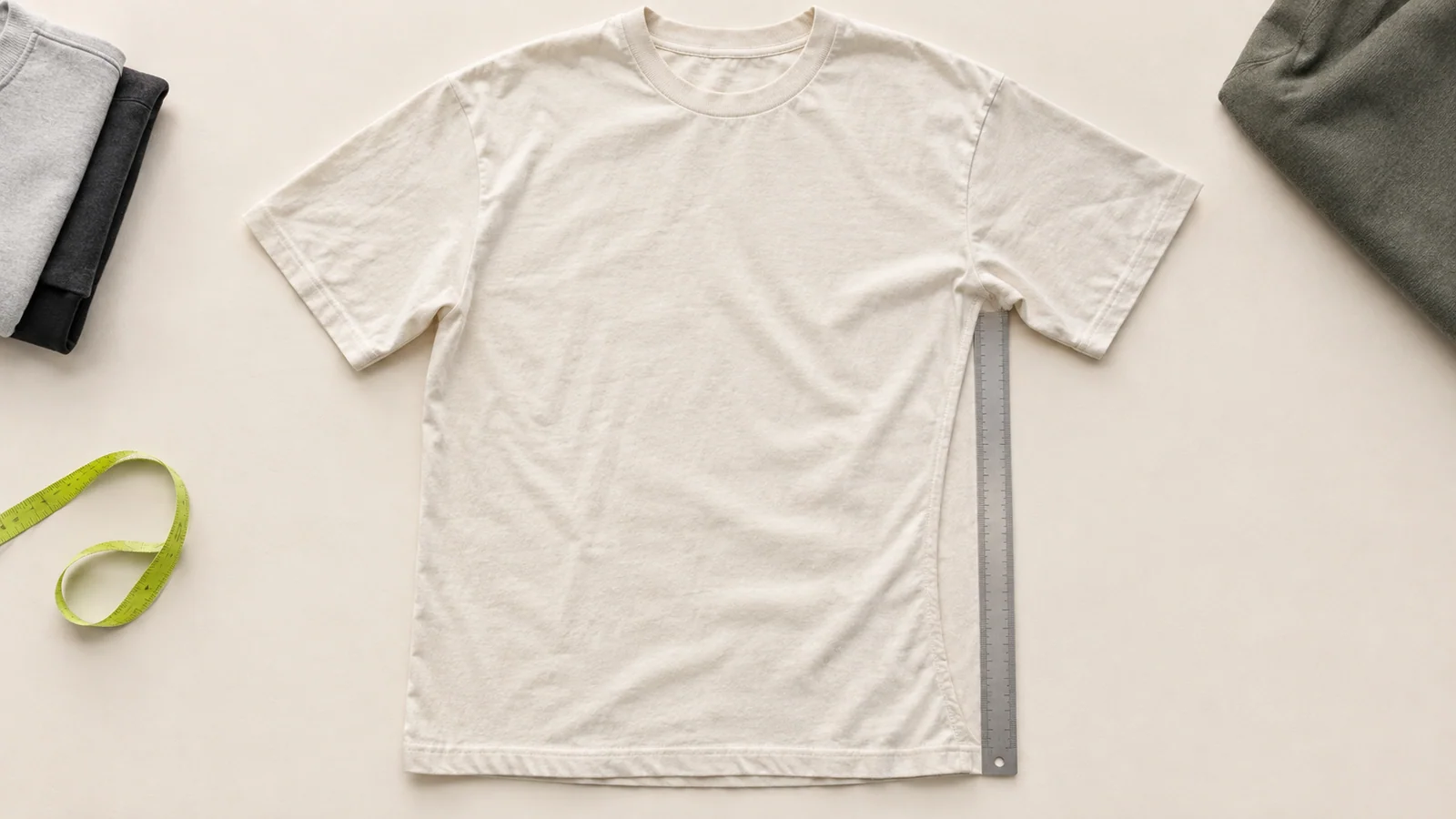
Yes, preshrunk T-shirts can still shrink. "Preshrunk" means the fabric or garment was relaxed or washed during production to remove much of the shrinkage, not all of it. How much remains depends on the fabric, the finishing and how the tee is washed and dried. The side seams can also twist toward the front or back after washing, which is a different problem from shrinkage. To know what your product does, wash the sample under agreed conditions, measure length and width separately before and after, check where the side seam lands, and write the result into your requirements.
Scope and evidence. This guide describes an in-house wash check for comparing samples. It is not a laboratory method and gives no pass limits: acceptable change is agreed per project, on the actual washed sample. Worked numbers are illustrative arithmetic. STREETTEECO's own practice is described in its own section.
"Preshrunk" on a tag or a quote is a description of a production step. It is not a promise that the garment won't change. Streetwear makes the gap easier to see. A boxy tee with a cropped length, a drop-shoulder fit or a garment-dyed hoodie shows a few centimeters of change more clearly than a regular basic does. This guide covers both checks a washed sample needs: how much the garment shrinks, and whether its side seams twist.
What "preshrunk" actually means
Cotton jersey is stretched in several directions while it is knitted, dyed and finished. Washing lets it relax, and that relaxation is most of what people call shrinkage. "Preshrunk" can refer to two different steps:
- At the fabric stage: before cutting, the fabric is relaxed or compacted so that less change remains in the finished garment.
- At the garment stage: the sewn garment goes through a wash or a garment dye, so much of the change happens before it reaches the customer. The pattern is made larger to allow for it.
Either way, some residual shrinkage usually remains. A hotter wash or a tumble dryer can bring out more than a gentle cycle, and some change can continue over the first few washes.
Why a preshrunk tee can still shrink
- Residual shrinkage: preshrinking reduces change but rarely removes it.
- Harsher care than expected: hot water and tumble drying usually shrink cotton more than a cool wash and line drying.
- Repeated washing: dimensional change can continue over several washes. Record the first wash and agreed repeat checkpoints instead of assuming it has stabilized.
- A different fabric lot or finish: bulk fabric may not relax exactly like the sample length did.
- How it was measured: a tee measured stretched before washing and relaxed after will look as if it shrank more than it did.
Shrinkage and twist are different problems
| Check | Shrinkage | Side-seam twist |
|---|---|---|
| What changes | The garment gets shorter or narrower, sometimes wider | The body skews: side seams swing toward the front or back |
| How you see it | Measurements before and after washing | Where the side seam lands at the hem when the tee lies flat |
| What to record | Length and width change, measured separately | How far the seam has moved at the hem, and in which direction |
| Where it can come from | Fiber, yarn, knit, finishing, care conditions | Yarn twist, knitting, fabric finishing, cutting and sewing |
A garment can pass one check and fail the other, so do both on the same washed sample.
Before you wash: set up the test
- Agree the care conditions with the supplier: water temperature, wash cycle, detergent and drying method (tumble or line). Use the care you will put on the label, or a harsher cycle if you expect customers to ignore it.
- Agree how many washes. Check after the first wash and after agreed repeat cycles to see whether the garment keeps changing. Keep care and measuring conditions consistent.
- Use more than one garment if you can, ideally in more than one size, so one odd piece doesn't decide the result.
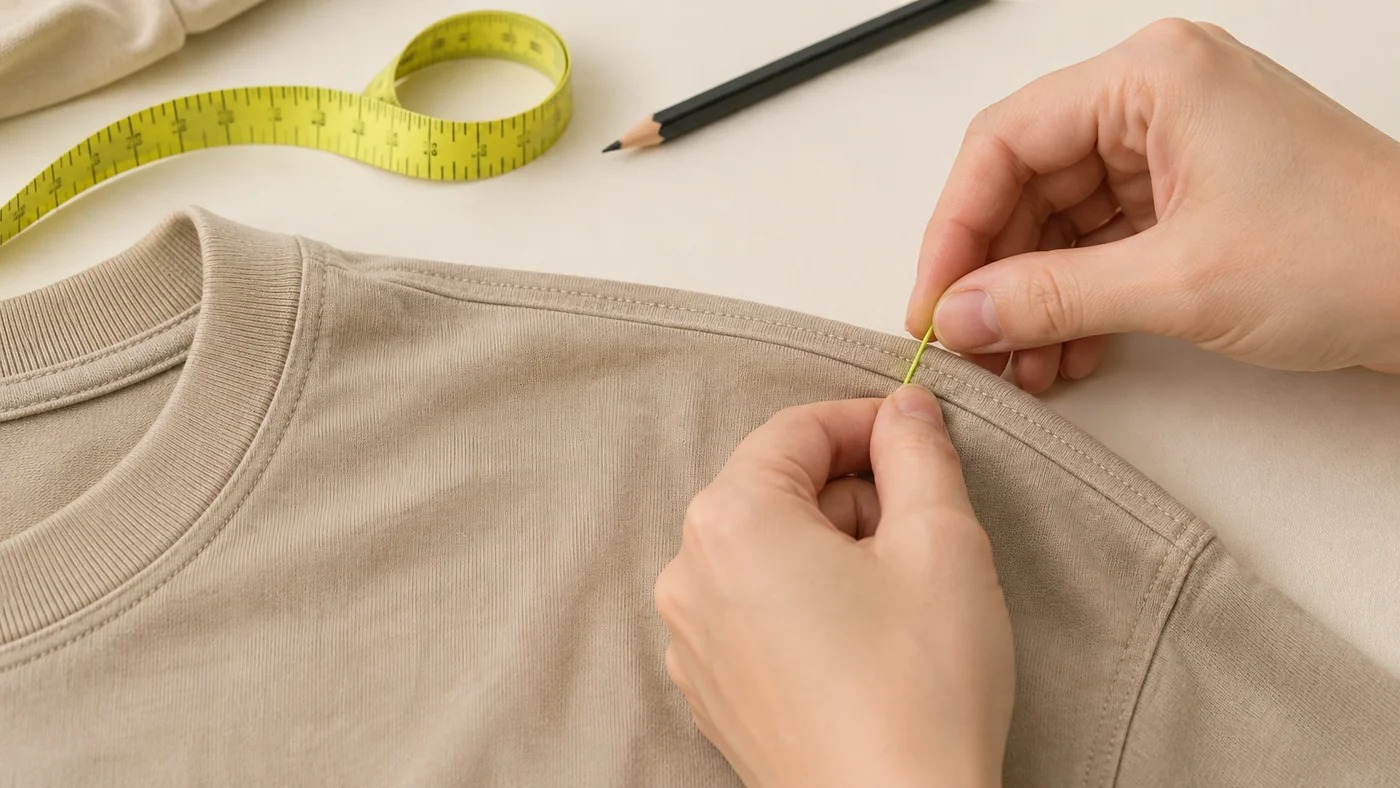
- Mark the measuring points. Small marks or thread tacks at fixed points make the before and after measurements comparable.
- Measure flat and relaxed. Lay the garment on a table, smooth it without stretching, and record every point before washing. After drying, measure the same points again. Use the shrinkage calculator for each point and save the results in your sample wash record.
What to measure on a tee and a hoodie
| Garment | Length points | Width points |
|---|---|---|
| T-shirt | Body length from the high point of the shoulder, sleeve length | Chest width, hem width, sleeve opening, neck opening |
| Hoodie | Body length, sleeve length, hood height | Chest width, hem width above the rib, hood width, cuff and hem rib, pocket width |
| Both | Side seam length, underarm to hem | Print or embroidery position from a fixed point |
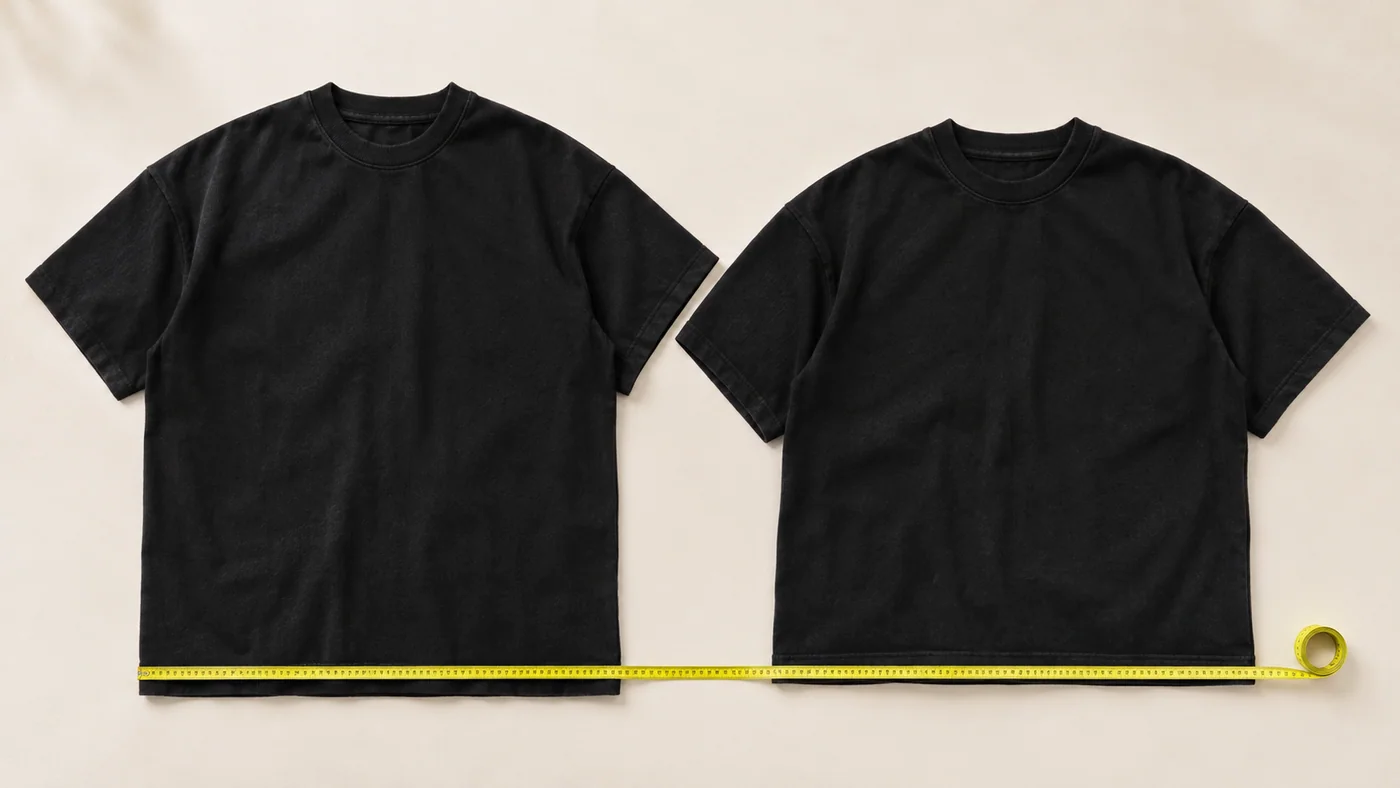
Record length and width separately. Jersey often changes more in length than in width, and can even grow slightly in width. A single overall percentage would hide that. Use the same points and method as your size chart. The tech pack checklist explains how to define each point and whether the chart describes the garment before or after washing.
After washing: record the shrinkage
Let the garment dry fully and rest flat, then measure the same points the same way. For each point, dimensional change is the difference divided by the original measurement:
Change (%) = (after − before) ÷ before × 100. A negative result means the garment shrank at that point, and a positive one means it grew.
Calculate your sample's dimensional change
Use the same unit (cm or inches) and the same measuring point before and after washing. Calculate body length and chest width separately. For a repeated-wash result, compare with the original unwashed measurement, not the previous wash.
Measurements are calculated in this browser and are not submitted or saved by this tool. There is no universal pass percentage: agree limits for each point before testing.
Open the fillable wash record and print or save it as PDF. Record the wash conditions, first and repeated wash results, seam movement and your agreed limits together. When you request the next sample, include the record and identify which measurement needs to change and by how much.
As an illustration of the arithmetic only: a body length of 70.0 cm before washing and 68.6 cm after is a change of −1.4 cm, or −2.0%. On a cropped boxy tee, 1.4 cm can move the hem noticeably against the waistband, which is why the after-wash length matters as much as the percentage.
After washing: check the side seams for twist
- Lay the washed tee flat on a table, front up, and smooth it without pulling. Line up the shoulders and the center front.
- Look at each side seam. On a garment without twist, it runs straight down from the underarm to the hem. With twist, it swings toward the front or the back as it goes down.
- Measure how far the seam has moved at the hem from where it should be. A common in-house way to express it is that distance as a percentage of the side seam length.
- Photograph the front and the back flat next to a ruler, and record the direction of the twist.
- On a tee with a large front or back print, check whether the print has rotated with the body.
Compare the result with the unwashed sample. A small offset that was already there before washing points to the cutting or sewing. A seam that only moves after washing points more toward the fabric.
What causes twist, and why a photo isn't enough
Twist usually comes from a combination of factors, and more than one can be involved:
- Yarn: single yarns carry twist energy that can make knitted loops lean.
- Knitting: on circular knitting machines, the courses can run at a slight angle.
- Fabric finishing: fabric set slightly skewed during finishing can return to its natural angle when washed.
- Cutting: panels cut off the line of the knit will hang skewed after washing.
- Sewing: uneven feeding of the two layers at the side seam can pull it off line.
A photo shows that the seam has moved, but not why. To find the cause, the supplier needs the washed garment or clear flat photos with measurements, the care conditions you used, and the fabric details. The fabrics and GSM page covers how to compare knit structures.
Can twist be fixed after the tee is made? Usually not permanently. Pressing can straighten the garment for a while, but twist from the fabric tends to come back after the next wash. Prevention happens at the fabric, cutting and sewing stages, before bulk.
Streetwear styles that need extra attention
- Boxy and cropped tees: the short body length is part of the design, so a small change in length shows. Approve the length on the washed sample. See the Heavyweight Boxy Tee.
- Oversized drop-shoulder tees: the wide body makes side seams more visible. A seam that swings forward is easy to see on a broad, flat front.
- Garment-dyed and washed tees: the garment shrinks in the dye or wash process, so the pattern has to be made larger. Approve fit on the washed sample, and recheck body length, width, sleeves and rib after the complete process. See garment dye and acid wash.
- Large prints and puff prints: shrinkage can distort a big print, and twist can rotate it. Check placement on the washed garment.
- Hoodies: fleece, rib and hood lining can shrink by different amounts. Check hood height, cuffs and hem rib as well as the body.
For washed styles, compare the Vintage Washed Tee with the Vintage Washed Streetwear Hoodie. Both are approved on the washed garment, with measurements taken after the complete wash.
Turn the result into a requirement
A "preshrunk" label describes a process. What you actually need is an agreed requirement that bulk can be checked against. Write down:
- The care conditions and the number of washes the check uses
- The measuring points and method, and whether the size chart describes the garment before or after washing
- The acceptable change at each key point, agreed with the supplier on the actual washed sample
- The acceptable side-seam movement, and how it is measured
- Photos and measurements of the approved washed sample, kept by both sides
Then repeat the same check on the bulk fabric or the first bulk pieces, because a new fabric lot can behave differently. See keeping sample and bulk matched for the rest of the reference pack, and the T-shirt GSM guide for how weight and structure affect the fabric you choose.
Method references and limitations
The check above is a practical comparison between samples, not a laboratory result. If an order needs a formal test, agree the method, sampling, laboratory and acceptance criteria before production. Commonly used references include ISO 6330 for domestic washing and drying procedures, ISO 5077 and ISO 3759 for measuring dimensional change, AATCC 135 and AATCC 150 for dimensional change of fabrics and garments after home laundering, and AATCC 179 and ISO 16322 for twist and spirality after laundering. Results under different methods are not directly comparable.
How STREETTEECO handles washed samples
Our fabric and fit consulting compares the garment before and after the agreed wash and drying cycle, and reviews twisting and seam behavior as well as length. For garment-dyed and washed styles, the approved wash sample is also the approved fit reference, with body length, width, sleeves and rib rechecked after the complete process. In bulk, quality control checks critical measurements against the approved tolerance, and a washed order is checked after the agreed complete process against the finished sample. Development samples take 7–10 working days. Bulk starts from 50 pieces per style per color. To start, send your style and care plan with a sample request.
FAQ
Do preshrunk T-shirts shrink?
They can. Preshrinking removes much of the shrinkage during production, not all of it. Hot washing and tumble drying can bring out more, so check a washed sample under the care conditions you expect.
How much shrinkage is normal for a cotton T-shirt?
There's no universal figure. It depends on the fabric, finishing, fit and care. Measure length and width before and after an agreed wash, and agree acceptable change with your supplier on the actual washed sample.
Why do T-shirt side seams twist after washing?
Twist can come from the yarn, the knitting, how the fabric was finished, how the panels were cut or how the side seam was sewn. Often more than one factor is involved, so a photo alone can't tell which.
Can a twisted T-shirt be fixed?
Usually not permanently. Pressing can straighten it for a while, but twist from the fabric tends to return after the next wash. It has to be prevented before bulk.
Do garment-dyed T-shirts shrink less after purchase?
Garment-dyed tees have already been through a wash, so much of the change happens before sale. Some can still remain, and dye batches can vary, so check the washed sample after a home wash too.
How many washes should a sample check cover?
Measure after the first wash and again after agreed repeat cycles to see whether the garment keeps changing. Agree the number and care conditions with your supplier; one wash does not establish dimensional stability.
Check your fit after the wash
Send your style, fabric and care plan. We'll measure the sample before and after the agreed wash and record shrinkage and side-seam position.
Request a QuoteOrder a Sample