How Many Pieces Should You Order for Your First Streetwear Drop?
Short answer
Size your first drop from two limits: the demand you can show, and the cash you can tie up in stock without needing it back quickly. Order the lower of the two, then fit styles and colors inside that number at your supplier's minimum. Every style and color you add spreads the same budget across more SKUs and leaves each one thinner, so a narrow range with real depth is usually easier to sell and reorder than a wide range with a few pieces of everything.
Scope and evidence. No guide can tell you how many units you will sell. The numbers below are illustrative planning arithmetic, not sales benchmarks or conversion rates. STREETTEECO's minimum and lead times are labeled as our own.
How many T-shirts to order for a first drop is a different question from what your manufacturer's minimum is. The minimum is the least a factory will make. Your first order should come from what you expect to sell and what you can afford to hold. This guide works through both, for a drop that may include hoodies as well as tees.
Start from demand you can show
Use evidence about your own buyers, not industry averages. Gather what you have:
- Waitlist or email sign-ups for this drop, and how engaged they are
- Pre-orders or deposits, which are the strongest signal because people paid
- Past sales of merch, samples or an earlier project
- Written interest from stockists or wholesale buyers
- Footfall at events or pop-ups, if you sell in person
Turn each source into an expected number of buyers using your own assumption, such as the share of waitlist sign-ups you expect to buy. Write the assumption down so you can check it after the drop. A conservative and an optimistic estimate are more useful than one number.
Set the cash ceiling
The second limit is cash you can lock into stock. From your budget, take out samples, freight and duties, photography and launch costs. What remains is the cash for stock. Divide it by the landed cost per unit, meaning garment, decoration, labels, packaging, freight and duties per piece. The result is the most units you can afford. Your first order is the lower of this ceiling and your demand estimate.
| Line | How to fill it | Your figure |
|---|---|---|
| Expected buyers (conservative) | From pre-orders, waitlist and past sales, using your stated assumption | [ ] |
| Units per buyer | Do people buy one piece, or a tee and a hoodie? | [ ] |
| Demand estimate | Expected buyers × units per buyer | [ ] |
| Cash for stock | Budget minus samples, freight, duties and launch costs | [ ] |
| Landed cost per unit | Garment, decoration, labels, packaging, freight and duties per piece | [ ] |
| Cash ceiling | Cash for stock ÷ landed cost per unit | [ ] |
| First order | The lower of the demand estimate and the cash ceiling | [ ] |
Count SKUs before you count units
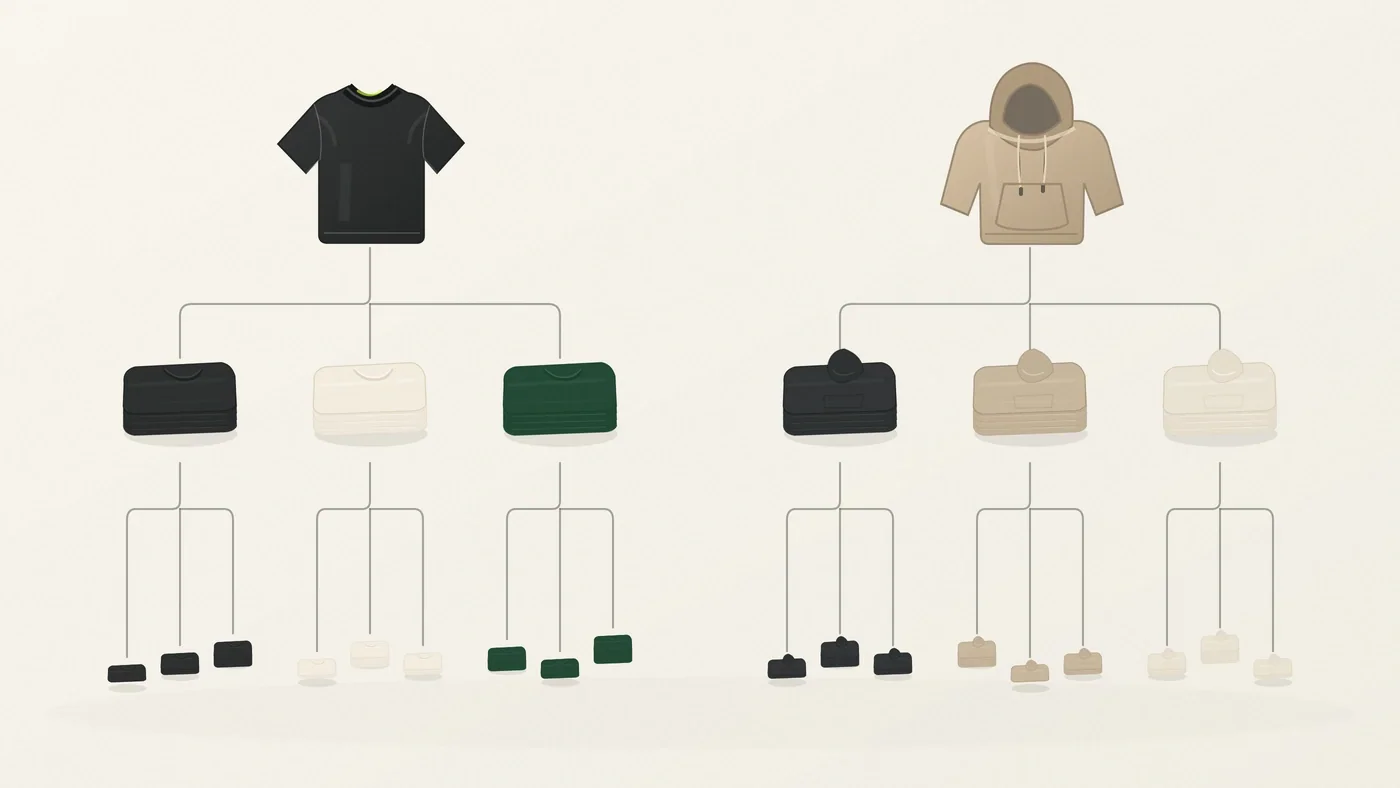
A SKU is one style in one color and one size, and every choice multiplies. Two styles × three colors × five sizes is 30 SKUs. With 300 units that averages 10 per SKU, and in practice some sizes end up with far fewer. Fewer SKUs give each one enough depth that a popular size doesn't sell out on day one while others sit unsold.
Minimums multiply too. If your supplier's minimum is 50 pieces per style per color, every extra color adds at least 50 units. That is the main reason to keep colors few on a first drop. How MOQ is counted explains the other minimums that can apply.
| Range | Style-colors | Smallest order |
|---|---|---|
| 1 tee, 1 color | 1 | 50 |
| 1 tee, 2 colors | 2 | 100 |
| 1 tee in 2 colors + 1 hoodie in 1 color | 3 | 150 |
| 2 tees in 3 colors each + 1 hoodie in 2 colors | 8 | 400 |
If your demand estimate is 150 units, the last line forces a choice: over-order, or cut products. It's better to make that choice on paper than after the stock arrives.
Tees and hoodies in the same drop
Hoodies cost more per unit and sell more seasonally, so each one uses more of the cash ceiling. If a hoodie is in the first drop, it often makes sense to run it in fewer colors than the tee, and to time the drop for the season when your customers buy hoodies. Fabric matters as well. Heavy fleece and jersey take color differently, so approve set colors side by side. The guide to adding hoodies to a T-shirt line covers what carries over from the tees and what needs its own sample.
A focused range might begin with a Streetwear Essential Tee and an Oversized Streetwear Hoodie. Use these as product references, then set the quantity for each style from your own demand, season and budget.
Match depth to your sales channel
- Your own website: you control timing, can take pre-orders, and can make a limited quantity part of the story.
- Stockists and wholesale: orders come in size and color packs and need stock you can repeat. See wholesale programs.
- Pop-ups and events: every size has to be on hand on the day, and a missing size is a lost sale on the spot.
Pick one main channel for the first drop. Splitting a small stock across channels makes every channel thin.
Splitting sizes without a standard ratio
There's no universal size ratio to copy. The right split depends on your audience, your channel and the fit itself. Customers often size down in an oversized style, for example. Use your own data: pre-order sizes, past sales and the questions customers ask. Keep the size run tight on a first drop. Before bulk, approve how the fit grades across the full size range, not only the sample size. The sample page explains the review order.
Use pre-orders and plan the reorder
Pre-orders turn guesses into data, because you place the bulk order after you see which colors and sizes people chose. The trade-off is that customers wait, so state the expected shipping window clearly.
Plan the reorder before the first drop ships. Decide what sell-through or stock level will trigger it, and work back from production and shipping time. At STREETTEECO, bulk production takes 14–25 working days counted from receipt of payment for the bulk order, plus shipping. Your trigger needs to leave enough stock to cover that gap. A reorder made against an approved sample and specification doesn't need new development, which is one reason the production route matters even at first-drop size.
Common first-drop mistakes
- Ordering every color you like and ending up with thin stock in all of them
- Setting units from the supplier's minimum instead of from demand
- Leaving freight, duties and packaging out of the cash ceiling
- Ordering the hoodie at the same depth as the tee without checking its cost per unit
- Keeping no cash back to reorder the item that sells
- Approving only one sample size and finding grading problems in bulk
Planning a first drop with STREETTEECO
Our minimum is 50 pieces per style per color. Development samples take 7–10 working days, and bulk production takes 14–25 working days from receipt of payment for the bulk order. Share your range and target quantities and we'll confirm minimums, the sample plan and timing in the quote. Browse streetwear T-shirt styles and hoodie styles for starting points, or read building a streetwear brand for how a small core range grows. When you're ready to compare suppliers, use the checklist in how to choose a streetwear manufacturer.
FAQ
How many T-shirts should a new brand order for a first drop?
There's no fixed number. Take the lower of your demand estimate, based on pre-orders, waitlist and past sales, and the units your stock budget covers. Then fit styles and colors inside that number at the supplier's minimum.
Is it better to order more styles or more units per style?
For a first drop, fewer styles and colors with enough depth in each size are usually easier to sell through and reorder than a wide range with a few pieces of each.
Should a first drop include hoodies?
It can, if the season and budget suit it. Hoodies cost more per unit, so run them in fewer colors than the tees and check their minimums separately.
What size ratio should I use?
Base it on your own customer data and the fit of the garment. There is no universal ratio, and an oversized fit can shift demand toward smaller sizes.
When should I reorder?
Set a trigger before launch, either a stock level or a sell-through point, that leaves enough stock to cover production and shipping time for the next order.
Size your first drop with us
Send your planned styles, colors and target quantities. We'll confirm the minimum for each item and a sample plan before you commit to bulk.
Request a QuoteBuild a Brand